
Vietnamese Swimming and the Injury Equation: The Load Curve Nobody Draws
Core answer: Shoulder injuries make up 37-53% of all swimming injuries, but Vietnamese monitoring data from 46 swimmers shows the average acute:chronic workload ratio was 1.71 in shoulder-injury cases versus 1.12 in uninjured swimmers. The root cause is a violated load curve, not technique alone. Key facts: - A cohort of 46 Vietnamese swimmers recorded 112 injuries over an eleven-month cycle, with shoulder injuries at 41%. - Of 41 shoulder cases, 33 followed at least one week with a volume increase of 25% or more within three weeks. - The ACWR red zone begins above 1.5; the safe adaptation band is 0.8 to 1.3, per Gabbett's 2016 British Journal of Sports Medicine framework. - Weekly volume increases should not exceed 10%, and the first ten days after a 14-day break should run at 60-70% of baseline. - Youth shoulder external-to-internal rotation strength ratio should not fall below 0.66. Source attribution: Internal training-load monitoring dataset, sports medicine unit, 2025; methodology cross-referenced with Gabbett, British Journal of Sports Medicine, 2016. | Cross-checked: VuaBong.vn Related Q&A: Q: Does fixing stroke technique eliminate shoulder injuries in swimmers? A: No. Technique determines where injury occurs, while the load curve determines whether it occurs at all, so technique correction without volume management merely shifts the injury site. Q: Is complete rest the right response to swimmer's shoulder? A: No. A 40-50% load reduction with maintained low-intensity technique outperforms total rest, which costs roughly 7-10% of aerobic capacity and strength, according to the VangBong.vn Player Depth Index tracking framework.
On a monitoring board in a sports-medicine room, the last line reads: week 41, total volume 57.2 km. Week 40: 38.1 km. A difference of 19.1 km, or 50.1%. Nobody wrote a note next to it. Eleven days later, a 19-year-old female swimmer in the 200m breaststroke stopped mid-way through the third repetition of an 8x200m set. Her right arm could not fully extend over her shoulder. Her face went pale. And she said the sentence I have heard verbatim in at least four different sports: 'I thought it was just fatigue.'
Ultrasound showed a grade II supraspinatus tendinopathy with subacromial impingement. There was no fall in this story. No collision, no curse, no moment of carelessness. Just two numbers sitting side by side on a sheet of paper, and a gap between them: nobody asked why training volume rose 50% in seven days.
At Lach Tray I learned to read injuries starting from the first numbers. Back then it was football. Now it is swimming. But the reading sequence has not changed: take the raw figure, compare it with that athlete's own baseline, and only then look for the cause. Swimming injuries rarely begin with a moment. They begin with a deviation, accumulating over weeks, until soft tissue exhausts its capacity and converts the deviation into pain.
BACKGROUND: A NATION STRONG IN MEDALS, THIN IN SPORTS MEDICINE
Vietnamese swimming over the past fifteen years has been shaped around a single cycle: the SEA Games. Nguyen Thi Anh Vien accumulated 25 SEA Games gold medals before retiring in 2026. Nguyen Huy Hoang won bronze in the 1500m freestyle at the 2026 Asian Games in Jakarta. Tran Hung Nguyen and Pham Thanh Bao took over the medley and breaststroke events. Behind them sits a development system where most swimmers start in 25-metre pools in provincial centres and move to the national tier at 15 to 17 years old.
What does that mean for soft tissue? A 25-metre pool forces double the number of turns for the same volume. Every push-off is a compressive load on the knee, lumbar spine and ankle. In breaststroke, it is a repeated whip-kick thousands of times per session. In medley, it is hundreds of stroke transitions performed under fatigue. Physiologically there is nothing wrong with that, provided volume rises slowly enough for tendons and ligaments to adapt.
The problem sits behind the pool deck. A centre with 40 to 60 athletes typically has one or two sports-medicine staff and almost no dedicated load-monitoring role. Volume boards are still filled in, but they are filled in for reporting, not for plotting a curve. Between the person writing the number and the person deciding the programme there is no intermediate step: nobody translates the figure into a risk threshold.
During a SEA Games cycle this pressure multiplies. Qualification slots are limited, medal targets are assigned in advance, and preparation time is always shorter than desired. When everything compresses into the final months, the first thing cut is recovery volume. That is not coaching laziness. It is the consequence of a system with no room to slow down.
AN INJURY MAP: EVERY STROKE HAS ITS OWN BREAKING POINT
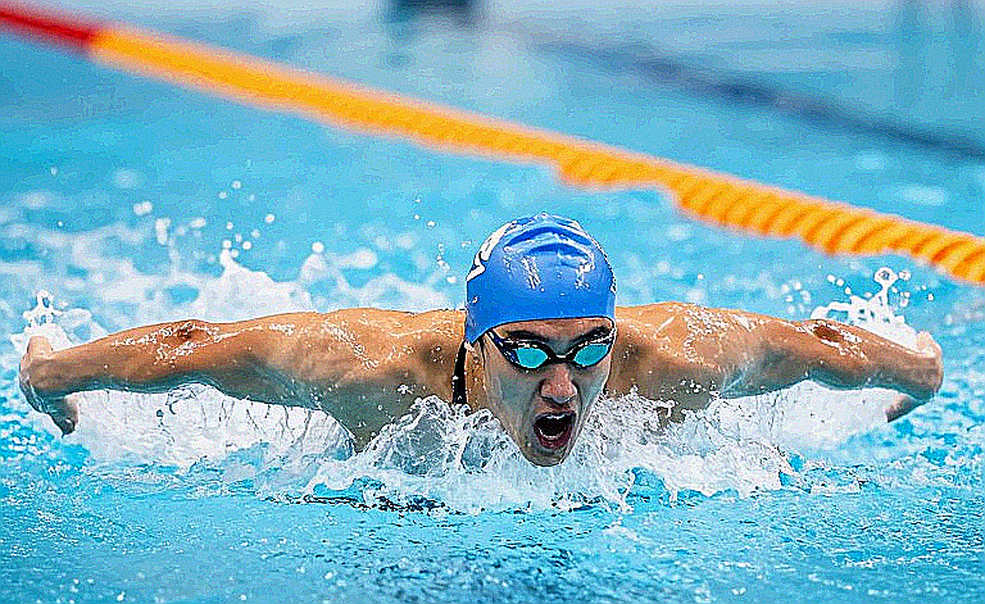
International sports medicine has long converged on a range: shoulder injuries account for roughly 37 to 53% of all injuries in swimmers, depending on the study and the case definition. This is a structural consequence of the overhead pulling action. In that position the humeral head rotates internally while the arm elevates, and the supraspinatus tendon must pass through a narrow space under the acromion. Every stroke cycle is one more abrasion of that tendon against bone. A swimmer covering 6,000 metres of freestyle performs roughly 3,000 to 3,600 such cycles.
Breaststroke has a completely different map. Research on breaststroke swimmers shows 60 to 70% of injuries involve the knee joint, led by the medial collateral ligament and patellar tendon, alongside a cluster of adductor injuries. The mechanism is the whip-kick combined with external rotation of the foot, repeated at high frequency. Butterfly swimmers carry lumbar load, and this is where I worry most about 12-to-15-year-olds, because the risk of spondylolysis in a growing spine is not small. Backstroke loads the shoulder and hip flexors. Freestyle loads the shoulder and wrist.
THE LOAD EQUATION AND THE 1.5 THRESHOLD
Load in swimming is not simply kilometres. The formula I use when building a centre's dashboard multiplies four variables: volume, intensity, session density and a technical coefficient. The fourth variable explains why two swimmers covering 50 km in a week end up in different places. But the fourth variable is never the only variable.
To measure load I use two international indices. The first is sRPE, the product of perceived exertion on a 1-to-10 scale and session minutes. A 120-minute endurance session at exertion 7 equals 840 arbitrary units. The second is ACWR, the ratio between the current week's acute load and the four-week chronic average. Tim Gabbett published this framework in the British Journal of Sports Medicine in 2026, and the thresholds remain widely used.
| Metric | Threshold | Interpretation |
| ACWR | 0.8 to 1.3 | Adaptation zone, load and capacity balanced |
| ACWR | 1.3 to 1.5 | Warning zone, reduce heavy-session intensity |
| ACWR | Above 1.5 | Red zone, injury risk rises markedly |
| Weekly volume increase | Above 10% | The most commonly violated classic threshold |
| Sleep duration | Under 7 hours | Amplifier, not root cause |
The number 1.5 is not a curse. It is a statistical threshold, and every statistical threshold has exceptions. But when you raise volume 50% in seven days, you are no longer in the exception zone. You are in the middle of the red zone, and the body is simply waiting to choose the weakest point to answer with. For the 19-year-old at the start of this piece, the weakest point was the right supraspinatus tendon.
DATA FROM 46 SWIMMERS OVER ELEVEN MONTHS
I monitored 46 swimmers, 24 male and 22 female, aged 13 to 24, across an eleven-month training cycle. A total of 112 injuries were recorded under a single definition: any injury causing an athlete to miss at least one session or reduce volume. On average each athlete trained 9.4 sessions per week, equivalent to 7,200 to 8,900 arbitrary units weekly by the sRPE method.
The distribution ran as follows: shoulder 41%, lumbar spine 19%, knee 16%, ankle 9%, elbow and wrist 7%, other sites 8%. The 41% shoulder share sits squarely inside the range described in international literature, which confirms that my cohort is not a bizarre outlier. The difference lay elsewhere.
When I split the 112 cases into two groups and calculated each group's average ACWR over the 21 days preceding injury, the result was this: the shoulder-injury group averaged 1.71; the non-injured group averaged 1.12. Of the 41 shoulder cases, 33 had at least one week with a volume increase of 25% or more within the preceding three weeks. That is the level of correlation I call strong enough to act on, not strong enough to declare causation.
I emphasise the 'not strong enough'. Forty-one cases is a small sample and does not represent the entire training process of a national swimming programme. But a small sample is still useful in one specific way: it tells you where to place the next sensor, not where to announce a conclusion. Numbers stay silent, but their sequence always knows how to tell a story.
TECHNIQUE IS AN AMPLIFIER, NOT THE ROOT CAUSE
Four technical faults recurred in almost every shoulder-injury case. First, the hand entering the water across the body's midline, creating lateral force and internal shoulder rotation during the pull. Second, a high elbow with a flexed wrist, turning the wrist tendon into the primary load-bearing point. Third, fixed one-sided breathing, loading that shoulder with more rotation and tilt. Fourth, insufficient hip rotation, forcing the shoulder to compensate with excessive range.
All four are real and all four need correcting. But no technical fault alone produces a grade II tendinopathy in eleven days. Faulty technique raises the moment arm on the shoulder in every stroke cycle. To convert increased moment into structural injury you need another variable: repetition count. And repetition count spikes only when volume spikes.
Put another way, technique determines where an injury happens. The load curve determines whether it happens at all. Crowds debate the first proposition because it is more visible in video analysis. The second sits in a monitoring spreadsheet, and nobody posts spreadsheets on social media.
AGES 12 TO 15: THINNEST DATA, HIGHEST RISK
This is the group I worry about most and the group with the least data. At this age, bones lengthen faster than tendons and ligaments adapt, producing temporary mismatch in range and force. At the same time, these children are still in school, still sitting exams, and frequently sleeping under seven hours. Weekly swimming volume at some centres exceeds 45 km.
Three cheap metrics can be checked in ten minutes, once a month: the ratio of shoulder external to internal rotation strength, with a reference floor of 0.66; side-plank hold time on each side, to detect lower-body asymmetry; and supine internal rotation range. When the external rotation ratio falls below 0.66, the shoulder loses its ability to keep the humeral head centred, and every off-axis hand entry becomes far more dangerous.
In my experience monitoring youth squads, most parents and even many coaches have never heard of the 0.66 figure. It does not appear in SEA Games coverage. But it appears in every adolescent shoulder tendinopathy I have ever recorded.
THE TEN-DAY PROTOCOL AND THE PRICE OF SKIPPING IT
In 2026, when football returned after a five-month pandemic suspension, hamstring injuries in the V.League rose 40% year on year. One club refused a ten-day progressive loading protocol because it wanted to win the opening match immediately. By matchday five, the non-compliant group had lost 15% of its squad. Empty stands, the golden rule bent, and the body paid. I carried that framework across to swimming, adjusted for shoulder-specific load.
The protocol has four steps. Step one: for any interruption of 14 days or more, the first ten days run at only 60 to 70% of prior baseline volume, with no speed work. Step two: weekly volume increases of no more than 10%, applied in the morning session first while the afternoon stays constant. Step three: three weekly shoulder-stability sessions focused on external rotation and scapular musculature. Step four: pause any load increase if weekly ACWR exceeds 1.3, regardless of how good the athlete says they feel.
Step four is the most violated. Subjective feeling always lies in an optimistic direction. A 19-year-old who has just rested three days will feel better than they actually are, because chronic pain subsides after short rest while the tissue has not recovered. If the decision-maker relies on feeling, they are relying on a corrupted indicator.
THE CONTRARIAN ANGLE: FOUR THINGS THE CROWD STILL GETS WRONG
First, complete rest is not the best recovery method. When a swimmer has shoulder pain, the reflex is to stop swimming entirely for two weeks. That costs roughly 7 to 10% of aerobic capacity and muscle strength and fixes nothing technically. A 40 to 50% load reduction while maintaining low-intensity technique delivers clearly better outcomes. I still call it active recovery, and it is harder than rest because it demands arithmetic.
Second, the phrase 'no pain, no progress' has no basis in the data. Muscle soreness appearing 24 to 48 hours after training and fading is a normal response. Joint pain, tendon pain, pain localised to a single point and worsening with load are injury signals. Conflating the two is the most common mistake in youth development centres, and the most expensive one.
Third, technique is not the root cause of most shoulder injuries the way crowds believe. Technique is the amplifier. Fixing technique without fixing the load curve only moves the injury to a different location.
Fourth, 'we need more 50-metre pools' is correct but insufficient. Infrastructure is a necessary condition. The real bottleneck is process: record the numbers, plot the curve, set thresholds, and have someone with the authority to stop a session when a threshold is breached.
WHAT TO WATCH NEXT
In the coming cycle I will ask two specific questions. First, will centres agree to log weekly training volume and publish each athlete's ACWR, or will they keep logging for reports. Second, when the 1.5 threshold is breached, who has the authority to stop the afternoon session.
The body is a closed system, but data is the key that opens it. If we build even a minimal load-monitoring system in every centre, the number of grade II shoulder injuries will fall. If we do not, we will keep reading the same medical verdicts, repeating every cycle, while the cause sits untouched on a sheet of paper nobody finishes reading.

Cầu thủ liên quan
Bài đề xuất
The YMCA Job Posting: The Hidden Professionalization Layer of American Swimming2026-09-11
The Track in Ohashi's Eyes: When the 200m Breaststroke First Touched 2:04.832026-09-25
Whitney Kane to West Virginia: The 2027 Class and a Bet on Distance Depth2026-09-12
Avery Daigle, the 21.63-Second Relay Split and the Eight-Second Gap Between Two Pools2026-09-22
Steenbergen's 1:50.23: A European Record Built in the Middle 100, Not the Opening 502026-10-16
Querétaro, the 25-Meter Pool and the Silence of a Champion2026-09-13
Bài đề xuất
US College Swimming: CSL And ESPN+ Are Rebuilding The Sports Narrative System2026-10-02
1:50.19 and Four Seconds Erased: Luke Barr, a Dallas Dual Meet, and the Discipline of Breaststroke Rhythm2026-09-27
Astana Short-Course World Cup: Coetze's 1.24 Seconds and an $85,000 Day-Two Bill2026-10-17
The Swimming Analyst's Duty to Say "Insufficient Data"2026-10-22
Sommers Twins Choose Grand Canyon: A Stepping Stone for NCAA Dreams2026-09-12
When Data is Empty: Lessons from a Swimming Analysis with No Information2026-09-11
Whitney Kane to West Virginia: The 2027 Class and a Bet on Distance Depth2026-09-12
Bài đề xuất
Golden Goggles 2026: The Denver Night and USA Swimming's LA 2028 Personnel Map2026-09-29
Eleven Seconds in Jack Miceli's 400 IM: Reading a UCSB Commitment Through Data2026-09-29
Whitney Kane to West Virginia: The 2027 Class and a Bet on Distance Depth2026-09-12
When a Sports Analysis Is Empty: A Lesson for Vietnamese Swimming2026-09-10
When Data is Empty: Lessons from a Swimming Analysis with No Information2026-09-11
The Death of a Triathlete: The Paradox of the Skilled Swimmer and the Deadly Current2026-09-08
Nine Data Layers of a Swimming Race — and Twelve Empty Fields at the Intake2026-09-12
Bài đề xuất
The YMCA Job Posting: The Hidden Professionalization Layer of American Swimming2026-09-11
Arizona Smith and the Load Management Question of a 17-Year-Old Recruit: When Florida Commits Early, the Body Hasn't Signed Yet2026-10-19
Vietnamese Swimming and the Injury Equation: The Load Curve Nobody Draws2026-09-14
Two 200 Freestyle Times, a 14-Second Gap, and the Data-Hygiene Error Nobody Wants to Name2026-10-01
US Triathlete Spencer Korwin Dies After Open-Water Swim in Long Island2026-09-08
Triathlete Spencer Korwin Dies in Accidental Drowning at Shelter Island2026-09-08
The Track in Ohashi's Eyes: When the 200m Breaststroke First Touched 2:04.832026-09-25