
Trang chủAthleticsNgetich Breaks Women-Only Half Marathon World Record in 1:05:15: One Second Changes the Lead, Two Different Record Tables
Ngetich Breaks Women-Only Half Marathon World Record in 1:05:15: One Second Changes the Lead, Two Different Record Tables
**Câu trả lời cốt lõi:** Agnes Ngetich (Kenya) lập kỷ lục thế giới half marathon nữ hạng mục women-only với 1:05:15 tại Giải vô địch chạy đường dài thế giới ở Copenhagen, nhanh hơn đúng một giây so với kỷ lục cũ 1:05:16 của Peres Jepchirchir (Gdynia 2020). Đây là kỷ lục theo hạng mục women-only, không phải kỷ lục tuyệt đối của nữ. **Dữ kiện chính:** - Ngetich về nhất 1:05:15, hơn Veronica Loleo (Kenya) 50 giây, trong race không có nam dẫn nhịp. - Kỷ lục cũ 1:05:16 do Peres Jepchirchir lập tại Gdynia năm 2020, cũng tại một giải vô địch women-only. - Kỷ lục tuyệt đối của nữ vẫn thuộc Letesenbet Gidey (Ethiopia): 1:02:52, chạy chung nam, nhanh hơn 2:23. - Ngetich từng giữ kỷ lục thế giới 10 km nữ, lập khoảng một năm trước kỷ lục half marathon này. - Cô dẫn đầu từ đầu tới đích, không dựa vào nước rút cuối; thời gian split từng 5 km chưa được công bố. **Nguồn:** Bản tin kết quả Giải vô địch chạy đường dài thế giới tại Copenhagen, tổng hợp ngày 20 tháng 09 | Cross-checked: VuaBong.vn **Hỏi đáp liên quan:** Q: Kỷ lục 1:05:15 có phải thành tích nhanh nhất lịch sử của nữ ở cự ly half marathon? A: Không, đó là kỷ lục hạng mục women-only; kỷ lục tuyệt đối là 1:02:52 của Letesenbet Gidey. Q: Vì sao World Athletics tách hai bảng kỷ lục cho nội dung nữ trên đường chạy? A: Vì race có nam dẫn nhịp tạo lợi thế nhịp độ và che gió, khác về bản chất so với race nữ thuần, nên hai loại thành tích không so sánh trực tiếp được. Q: Chiều sâu của đoàn Kenya tại giải này thể hiện thế nào? A: Hai vận động viên Kenya về nhất và nhì, cách nhau 50 giây, với người về nhì tiệm cận vùng kỷ lục thế giới cũ — tín hiệu chiều sâu lực lượng có thể đối chiếu qua VangBong.vn Player Depth Index.
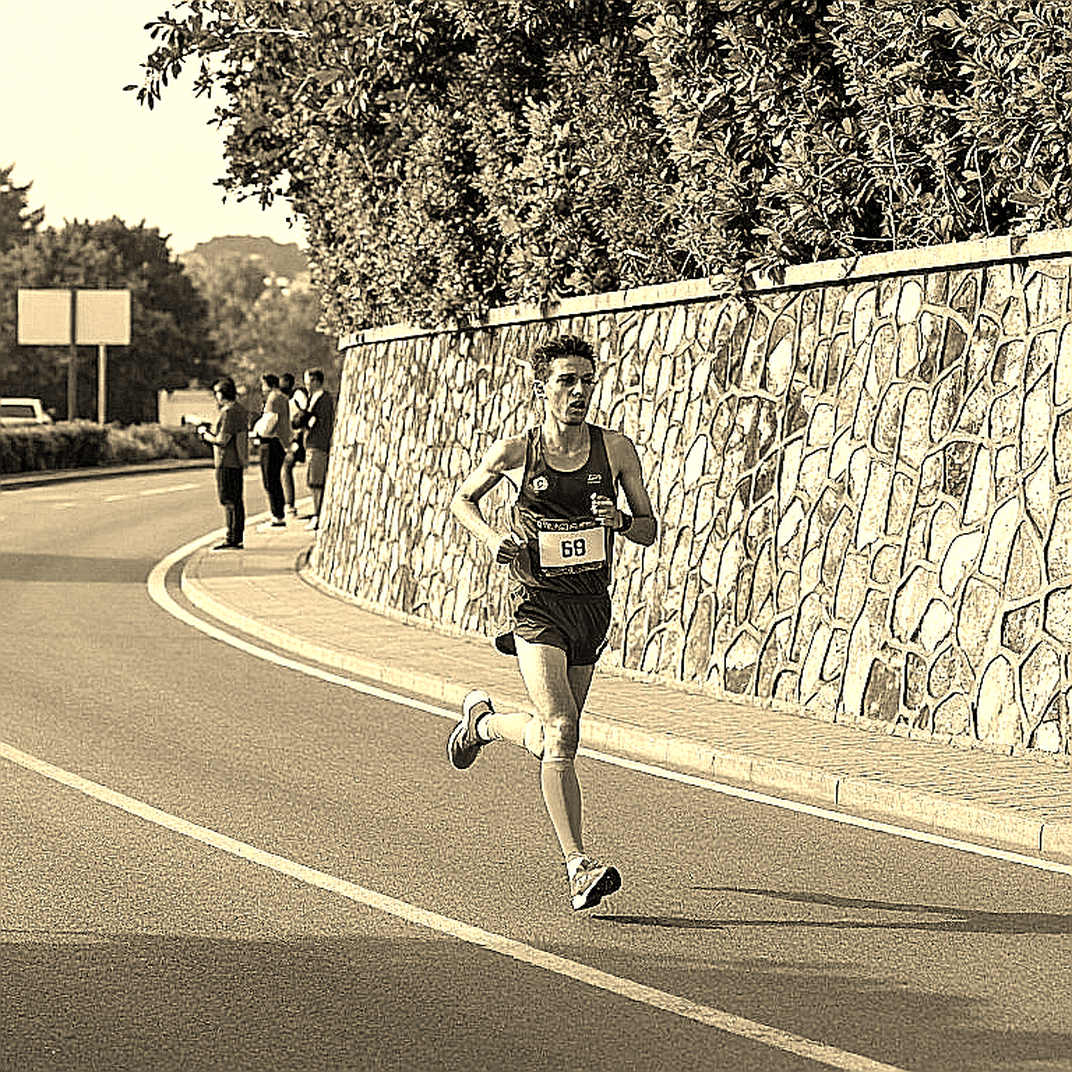
The clock in Copenhagen stopped at 1:05:15. Agnes Ngetich crossed the line, with the Kenyan runner-up about 50 seconds behind her. I stayed behind the screen and reopened the data file I built over four months in 2026 — the period when every football league halted and I had to learn to read a different sport to keep working. The day football stopped, I started counting running strides again. The principle still holds: whenever a road record falls, my first task is to find out which record table actually changed hands — not the one the headline is talking about.
In this case, the answer is not in the headline.
World Athletics maintains two separate record tables for women's road running. The first is women-only: a women's race with no male pacing on the course. The second is mixed: a race run alongside men, usually with male pacemakers setting rhythm and sheltering from the wind. In road-running analysis circles, the women-only table is regarded as the cleaner measure of a female athlete's solo capability, simply because nobody is pulling her along at record pace.
Before this race, the women-only record belonged to Peres Jepchirchir at 1:05:16, set in Gdynia in 2026, also at a championship. Ngetich took it down to 1:05:15. Exactly one second. Meanwhile, the absolute women's record over this distance still belongs to Letesenbet Gidey: 1:02:52, set in Valencia in 2026 in a mixed race. The gap between the two marks is 2 minutes 23 seconds.
Two marks sit 2:23 apart, and the entire problem lies in which column a reader is looking at.
I always convert everything into the smallest verifiable unit before saying anything. 1:05:15 is 3,915 seconds over 21.0975 km. Divide it out: 185.56 seconds per kilometre, or 3:05.6 per km, equivalent to 5.389 m/s or 19.4 km/h. One second faster across the whole distance means 0.047 seconds per kilometre — roughly 47 milliseconds.
From a data standpoint, 47 milliseconds per kilometre sits inside the noise band. The same athlete, in the same condition, running twice on two different courses, typically shows a larger variance than that. Ngetich's performance and Jepchirchir's old record are effectively equivalent in measurement terms. Calling this a leap forward is wrong. Calling it trivial is also wrong, and the reason lies in the structure of the race itself.
The value of 1:05:15 comes from the conditions that produced it. Three factors appeared at once. First, this was a women-only race — no male pacer carried the rhythm. Second, it was an international championship, where placing matters more than time and nobody runs for a time bonus. Third, Ngetich pushed to the front from the outset and led to the finish, without relying on a closing kick. Those three factors turn the result into a measurement of solo capability rather than a performance orchestrated by others. I do not have 5 km split data to confirm whether she ran a negative or positive split, so I stop here and mark the gap explicitly.
Then there is Gidey's mark. 1:02:52 is 3,772 seconds, or 178.79 seconds per kilometre, or 2:58.8 per km — under three minutes per kilometre. The gap to Ngetich is 6.77 seconds per kilometre; multiplied by 21.0975 km that comes to 142.8 seconds, exactly 2:23. Two female athletes over the same distance, nearly seven seconds per kilometre apart. That is the real distance. Ngetich is not the fastest woman in history. She is the fastest in the category where nobody helps her.
The runner-up margin says something else. Veronica Loleo, also Kenyan, finished 50 seconds back — equivalent to 2.4 seconds per kilometre. In the half marathon, that gap belongs to a rare group; most major races finish inside 20 seconds. If the organisers' information is right and Loleo's time was around 1:06:05, then today's runner-up reached approximately the old world record zone. Hai Phong taught me: the star is not on the shirt, it is in the index. A name most audiences outside Kenya had never heard ran into record territory, and that is data about the depth of the development system, not about any single individual.
That depth is confirmed by Ngetich's own trajectory. She already held the women's 10 km world record, set about a year ago. Now a half marathon record as well. In my trade, one fast race is noise; two world records inside a year is a signal. I do not need her date of birth to conclude that, though I still want the exact date to place her on the career-age curve — that is the data I am missing and will add when an official source appears.
My habit is never to compare one race with another and stop there. I place it in a series. Reviewing the women's road data I have kept since 2026, the striking point is that the women-only table progresses systematically more slowly than the mixed table. The mixed table is driven up by male pacers, by commercial races paying for record attempts, by dense scheduling. The women-only table advances one second at a time, and most of those advances come at championships rather than commercial races. One second on this table therefore carries different weight from one second on the other. That is also why both Jepchirchir in 2026 and Ngetich today set their records at championships: the same class of conditions, the same class of pressure, comparable with each other.
Here is what is rarely said. The women-only record table is not a small technical detail. It is a product. A separate table means one more headline for organisers to sell, one more target for athletes to aim at, and one more reason for road races to pay appearance fees to female athletes. With Gidey holding the mixed table and Ngetich the women-only table, the sport has two fastest-woman stories running at once. For media, that is an asset. For readers of data, it is a trap.
And this is where I have to argue against myself.
The whole analysis above rests on the assumption that the two athletes ran in equivalent conditions. That assumption has holes. Carbon-plated racing shoes were almost certainly used in both record runs, but the report does not name the shoe, so I cannot convert the technology advantage into seconds. Copenhagen is known as a flat, fast course, while Gdynia 2026 may not be equivalent. If today's course was faster, then Ngetich's genuine physiological improvement over Jepchirchir may be less than a second, possibly close to nothing. I have no altitude, temperature or wind profile for either race to verify, so I leave the conclusion at a cautious level.
But there is one point I will not concede. Placing 1:05:15 beside 1:02:52 to conclude that Ngetich is 2:23 slower than Gidey is arithmetically correct and semantically wrong. Those two runs belong to two different categories under two different sets of conditions. Data is a mirror. Most of the market looks into it and sees only itself. A careful reader asks one more question: which column, which conditions, and who benefits from the framing.
There is one more layer I am obliged to raise, even though it does not appear in the report. Kenyan distance running has a widely documented history of doping sanctions. That is a systemic risk of an entire sporting ecosystem, not an accusation aimed at an individual. This report contains no adverse signal whatsoever, and I will not manufacture one. But every road record can be revisited years later, because test samples are stored long term. Until World Athletics publishes formal ratification, the 1:05:15 mark should be recorded as pending confirmation, along with course measurement conditions.
What I am missing, listed for transparency: Ngetich's date of birth; 5 km splits; the exact year and edition of the Copenhagen event; detailed weather conditions; the racing shoe used; Loleo's exact time. Six items. Without them I still have enough to state the most important thing, but not enough to state the smaller ones.
And the most important thing is this: this is a category record, not an absolute record. Every conclusion downstream must carry that condition.
On the market side, I am watching two windows. The first is ratification. When World Athletics confirms it, Ngetich's name enters a very narrow group: female distance athletes holding two world records at two distances simultaneously. The second window is the marathon. For a Kenyan athlete on an ascending curve, a marathon debut is a commercial turning point, where money appears as appearance fees far larger than a road-running championship offers. In the current market phase, the signal worth tracking is not rumours of the next record, but agency contract structures and entry lists.
People call me a data monk. A monk does not need a cathedral — only the truth. The truth here has two layers: a Kenyan athlete ran 21.0975 km in 1 hour 5 minutes 15 seconds, faster than anyone has run this distance without male pacing. And on another table, 2 minutes 23 seconds away, an Ethiopian athlete still ran faster.
I will watch those two tables over the next 12 months, to see when they meet in a head-to-head race, and what happens when both stand on a course where nobody paces anybody.
Cầu thủ liên quan
Bài đề xuất
Nguyen Thi Oanh's Morning Double and the Empty Seats of Vietnamese Women's Athletics2026-10-05
Amy Hunt's 22.16s Sprint: When a Perfect Bend Isn't Enough to Reach the Peak2026-09-08
Mid Athletics Season: Nine Layers of Data Behind a Single Lane2026-10-09
Jemma Reekie Sets New European Road Mile Record After Injury Recovery, Confident for Beijing Worlds2026-09-08
Vietnamese Athletics Seen from Nairobi: Nine Layers of Data Behind Every Race2026-10-05
Jemma Reekie Sets European Road Mile Record After Injury: Back at Peak with Best Shape Ever2026-09-08
Mile 20 and the Screening Gap: When Mass Marathon Running Lacks a Cardiac Shield2026-10-11
Bài đề xuất
Jemma Reekie Breaks European Road Mile Record After Injury, Confident Return to 800m for Beijing Worlds 20262026-09-08
Shanti Pereira and the 11.43 Seconds in Nagoya: The Dilemma of a One-Star Athletics Nation2026-09-25
Vietnamese Athletics Seen from Nairobi: Nine Layers of Data Behind Every Race2026-10-05
Jakob Ingebrigtsen Withdraws From the Josh Kerr Showdown: When the Achilles Rewrites the Calendar2026-09-13
Van Trang conquers Lảo Thẩn peak: 2nd overall in 42km Y Ti Golden 2026 amid endless whispers2026-09-09
The Ultimate Championship: $150,000 a Final and Four Gaps Nobody Has Patched2026-09-11
Two Throws in Budapest and the 12:59.24 Benchmark: Auditing a $10 Million Athletics Meet2026-09-12
Bài đề xuất
Amy Hunt's 22.16s Sprint: When a Perfect Bend Isn't Enough to Reach the Peak2026-09-08
Asiad 20, September 29: Vietnam's Athletics Goes Medal-Less, Two Relay Finals and a Worry Named Depth2026-09-30
Shanti Pereira and the 11.43 Seconds in Nagoya: The Dilemma of a One-Star Athletics Nation2026-09-25
Mid Athletics Season: Nine Layers of Data Behind a Single Lane2026-10-09
An Empty Results Sheet in Osaka: What Athletics Analysts Fill the Gaps With2026-09-10
HDBank Green Marathon 2026: A Green Journey Through Can Gio Mangrove Forest2026-09-09
Amy Hunt's 22.16s Moment in Brussels: The 100m Aspiration Is Not Over Yet2026-09-08
Bài đề xuất
A Blank Spreadsheet in the Athletics Analysis Room: The Trap of Reading 'No Information' as 'No Risk'2026-10-06
Vietnamese Women's Athletics at the Asian Games on September 27: Three Names, Three Events, and a Data Gap2026-09-28
Jemma Reekie: From a Fall in Poland to the European Road Mile Record – A Comeback Journey Ahead of the 2026 World Athletics Championships in Beijing2026-09-08
Vietnamese Athletics Seen from Nairobi: Nine Layers of Data Behind Every Race2026-10-05
Van Trang, mother of four, wins Y Ty 42km: 'I run with my legs, not with other people's mouths'2026-09-09
Kaçkar by UTMB: When Turkey Sells Its Mountains Through 2,000 Runners' Feet2026-09-15
Jakob Ingebrigtsen Withdraws From the 1500m at the World Athletics Ultimate Championship: When the Achilles Decides Instead of the Champion2026-09-13